This idea was triggered by a ready-made project we received. It contained an XBee module which was used in transparent mode (in short: UART to XBee), connected to the PC via a good old RS232 interface. I was lucky to have a PC with one COM port, but I decided to make a small PCB to connect it to USB using a FTDI-cable.
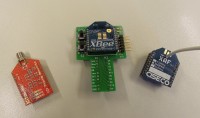
This idea was triggered by a ready-made project we received. It contained an XBee module which was used in transparent mode (in short: UART to XBee), connected to the PC via a good old RS232 interface. I was lucky to have a PC with one COM port, but I decided to make a small PCB to connect it to USB using a FTDI-cable. XBee modules have 2mm pitch pinheaders for connection to the outside world, and they don’t match any existing breadboard or prototyping board, so a breakout board with standard .1” pinheaders was a quite nice, though not very original idea. At that time we just started selling the microcontroller T-Boards designed by Andrew Retallack, and the response from our readers to the boards was encouraging enough to think about more T-shaped PCB’s to be used in combination with breadboards. So, why not a T-board for XBee modules? Not only are the 20 pins of the XBee routed to two standard .1” pitch pinheaders, its UART pins are connected to a 6-pin header for a 3.3V FTDI-cable. Xbee modules are 3.3V devices, and their I/O pins are not 5V tolerant! Even a 3.3V FTDI-cable has a 5V supply voltage on its VDD pin, so to power the T-Board via USB a 3.3V voltage regulator (IC1) is needed. To make the board even more suitable for prototyping two push buttons (Reset and Commissioning) and two LED’s (RSSI and status indication) were added. At a later stage I realized that this T-board is also suited for other wireless modules than XBee only. For that reason I decided to even route the two NC (Not Connected) pins to the bread board connections (just in case). Ciseco makes XRF-boards, Microchip (formerly Roving Networks) makes WiFi and Bluetooth modules with the same footprint and even matching pin assignment for the most vital functions. And maybe I missed other modules from other manufacturers that can also be made bread board-ready using this T-Board.
Want to build a project?
Bring your design to life with the Elektor PCB Service, powered by Eurocircuits. Upload the project files and order professionally manufactured PCBs or assembled boards through a proven European production platform.
Supporting KiCad, Eagle, Gerber, and ODB++ formats, the service is suitable for everything from prototypes and validation builds to series production and volume manufacturing.



Discussie (0 opmerking(en))